Complete Guide to Things to Do in Luxor
Luxor ruins you for other cities. That sounds dramatic but ask anyone who's been and most of them will say something similar. You spend a few days in Luxor walking through temples that were already ancient when the Roman Empire was young, crawling into tombs decorated with paintings that are still vivid after three thousand years, floating above the west bank in a hot air balloon as the sun comes up over the Nile, and then you go home and try to explain it to someone who hasn't been. You can't really. You just end up booking another trip.
The city sits on the east bank of the Nile in Upper Egypt, about 670 kilometres south of Cairo. UNESCO estimates that roughly a third of the world's ancient monuments are concentrated here. Both banks of the Nile tell a different part of the story. East bank for the living, temples, markets, the city itself. West bank for the dead, tombs cut into limestone cliffs, mortuary temples, the Valley of the Kings.
Here's what's actually worth your time.
1. Karnak Temple Complex
Not a temple. A city of temples. That distinction matters because nothing prepares you for the scale of it until you're standing inside the Hypostyle Hall looking at 134 columns, some of them 21 metres tall, every surface covered in hieroglyphs and painted reliefs. It's the kind of place where you stop walking and just stand there for a while because moving feels like the wrong response.
Pharaohs added to Karnak for over a thousand years, each one building on or over what the previous ruler had left behind. The result is gloriously layered and complicated and vast. A single visit covers maybe half of it properly if you're moving at a decent pace.
Go early in the morning. Before 8 am if possible. The light is better, the crowds haven't arrived yet, and the heat is manageable. The Sound and Light Show in the evening is worth doing at least once, it gives Karnak a completely different atmosphere that's hard to describe but easy to remember.
2. Luxor Temple
Right on the Nile Corniche in the city centre, which makes it easy to stumble into without much planning. The entrance is through an avenue of sphinxes that leads to a pylon flanked by two colossal statues of Ramses II. One of the original obelisks is still standing in front. The other one is in Paris. The French took it in 1833 and sent a clock in exchange. The clock stopped working. The obelisk is still in Paris.
Visit in the evening. The temple is lit after dark and the atmosphere shifts completely. Cooler, quieter, the lighting does something to the stone that makes it look slightly unreal. One of the better evening experiences in Egypt.
3. Valley of the Kings
This is what most people come to Luxor for. Over 60 royal tombs cut into the limestone cliffs of the west bank, including the tomb of Tutankhamun, found largely intact by Howard Carter in 1922 in what remains one of the most significant archaeological discoveries ever made.
The standard ticket covers three tombs. Choose carefully because the quality varies a lot. Tomb of Ramses IV is spectacular and usually quieter than the obvious choices. Tutankhamun's tomb needs a separate ticket and is smaller than most people expect. The mummy is still there though, and for most visitors that fact alone settles the debate about whether the extra cost is worth it.
The Valley is best done early. By mid-morning in peak season the tour groups have arrived in numbers and the experience is considerably different.
4. Temple of Hatshepsut
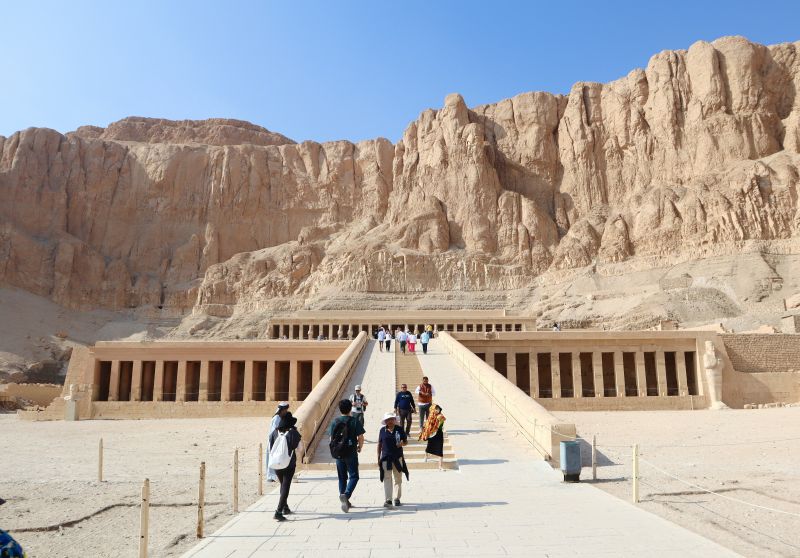
Hatshepsut ruled Egypt for over twenty years and was one of its most successful pharaohs by any measure. Her mortuary temple at Deir el-Bahari is built into the west bank cliffs in a way that looks almost contemporary, three colonnaded terraces rising against the rock in clean horizontal lines. It's a striking building. Genuinely striking in a way that a lot of ancient sites aren't.
After her death her successor spent considerable effort trying to erase her from history, defacing her image throughout the temple. He didn't entirely succeed.
5. Nefertari's Tomb in the Valley of the Queens
The Valley of the Queens sits near the Valley of the Kings and gets a fraction of the visitors, which is already a point in its favour. The tomb of Nefertari, wife of Ramses II, is considered by many Egyptologists to be the most beautiful tomb in Egypt. The paintings inside are extraordinarily well preserved, colours still vivid, scenes still detailed, in a way that makes the three thousand years since they were made feel genuinely impossible to process. Numbers allowed inside each day are limited. Book ahead. This one is worth planning around.
Customize Your Ultimate Luxor Trip Now!
6. Hot Air Balloon Over the West Bank
Balloons launch before sunrise and drift over the Valley of the Kings, the Temple of Hatshepsut, and the surrounding desert as the light comes up over the Nile. From up there the whole geography of ancient Thebes starts to make sense in a way it simply doesn't from ground level. The relationship between the temples and the cliffs, the scale of the necropolis, the way the entire west bank was organised around a single idea.
The early start is non-negotiable and completely worth it. Book through a reputable operator and check reviews first. Standards vary more than they should.
7. Luxor Museum
About 150 objects, each given proper space and lighting. No cramped cases, no missing labels, none of the organised chaos of the Egyptian Museum in Cairo. Two mummies, Ahmose I and Ramses I, are here along with statues and artefacts from Karnak that are extraordinary at close range.
If you've spent the morning walking through vast open-air complexes and need somewhere cooler and quieter to process what you've seen, this is the place. Two hours here is time well spent.
8. Medinet Habu
The mortuary temple of Ramses III on the west bank and one of the most overlooked sites in Luxor. Probably because the Valley of the Kings takes most of the available time and energy. That's understandable but it's a mistake if you can avoid it.
The outer walls are covered in detailed military reliefs including sea battle scenes that are rare in Egyptian art. The painted reliefs inside still show traces of original colour in places. The complex is large and usually quiet in a way that feels genuinely luxurious after the crowds elsewhere on the west bank.
9. Felucca on the Nile at Sunset
The light in Luxor at golden hour does something specific to the landscape. The stone goes warm and orange, the water catches it, the west bank cliffs shift colour in a way that makes the whole scene look slightly too beautiful to photograph convincingly. An hour on a felucca during that window costs almost nothing and stays in your memory disproportionately long relative to how simple it is.
10. The Luxor Souk
Behind Luxor Temple, covered and busy and a genuine mix of tourist market and actual local commerce. Spice stalls, perfume shops, alabaster, fabric, fruit, vegetables, places that have no particular interest in selling to tourists at all. Go in the evening when it's cooler and the energy picks up. Bargain for anything that seems negotiable, which is most things.
Stop for a glass of fresh sugarcane juice somewhere. Pressed to order, costs almost nothing, and after a full day in the Luxor heat it's one of the better things you can put in your body.
Getting Around and Staying Sane
West bank sites need early mornings. The heat and the tour groups both arrive around the same time and neither improves the experience. A Luxor Pass covers entry to most sites and works out significantly cheaper than paying individually if you're planning to be thorough. Drink water constantly and then drink more water. The sun on open archaeological sites in Luxor is not something to underestimate.
Local ferries cross the Nile between the two banks for almost nothing. Hiring a driver for the west bank is convenient but agree on the price before you get in the car. Donkeys and bicycles are genuinely viable options for getting between west bank sites and are significantly more enjoyable than they sound.
Luxor is the kind of place that changes how you think about time. Not in an abstract way but specifically, because you've stood inside a room that a human being was buried in three thousand years ago and looked at art made by other human hands that is still there. That experience is available to anyone who makes the trip and it's one of the most remarkable things Egypt offers. Have a look at our Egypt tours when you're ready to start planning.
Frequently Asked Questions
1. How many days do you need in Luxor?
Three days minimum. Four or five if you want to go deeper or add a day trip to Abydos or Dendera, both of which are worth it.
2. When is the best time to visit?
October through April. Summer temperatures regularly exceed 40 degrees and outdoor sightseeing in that heat is genuinely punishing.
3. What are the absolute must-dos?
Karnak, Valley of the Kings, hot air balloon at sunrise, felucca at sunset.
4. How do you get between the east and west bank?
Local ferry. Cheap, easy, runs regularly. Taxis and organised tours if you want something arranged in advance.